

Is paraphrasing plagiarism? The short answer is: it depends. What defines the difference between the original text based on respectful resources and the plagiarized one is the quality of information processing.
Is it illegal to paraphrase?
Definitely, it is not illegal to paraphrase. However, one should not confuse proper paraphrasing with synonymization. You need actually to work with information, absorb it, and transform it into something new instead of just replacing the words.
The common mistakes leading to poor paraphrasing are:
- to maintain the author’s sentence structure and tone of voice, repeating their method of expression;
- to apply only minor changes to the structure;
- not to use quotation marks to indicate the phrases coming from the author directly;
- to mix up paraphrasing with synonymization, which, when overused, is considered plagiarism.
The thing is, modern plagiarism-checking tools can detect these kinds of changes and define your work as plagiarised. Let’s pay attention to an example from PurdueOWL website:
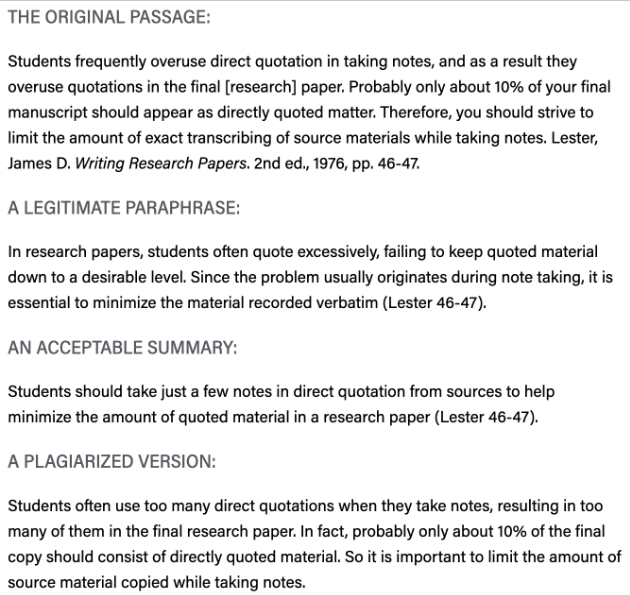
When we scan the poorly paraphrased version, it is evident that rewording is not good enough to trick the detector. PlagiarismCheck.org still finds similarities:
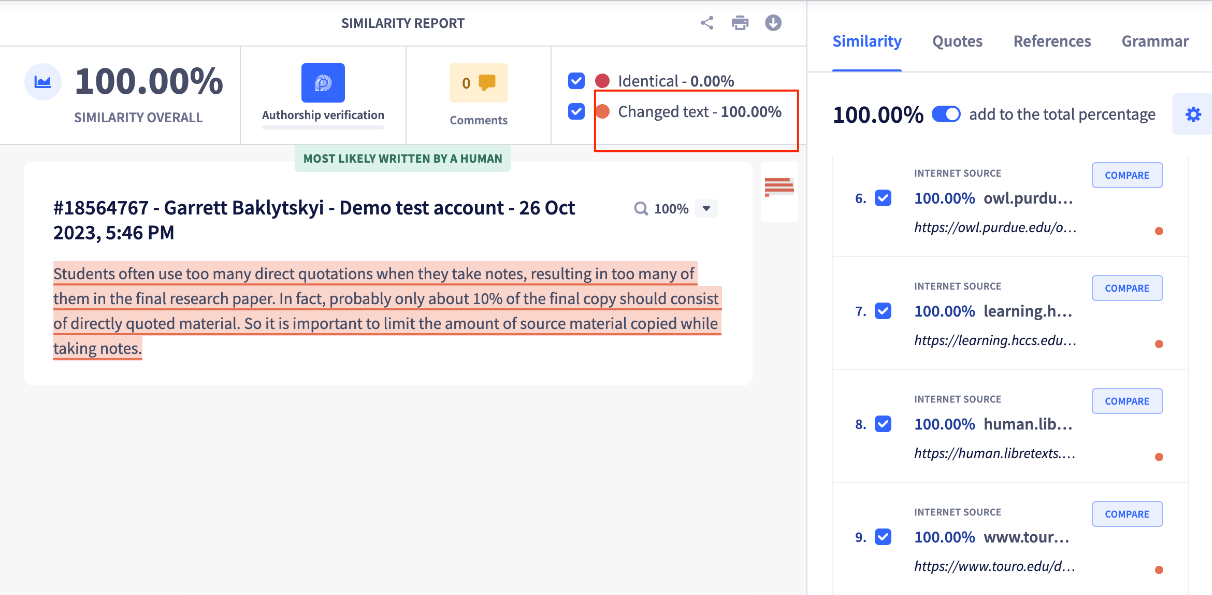
So, is using paraphrasing tool cheating? Not necessarily, but you need to work with the text. Replacing some words and changing the order is definitely not enough to make the writing original.
Can you avoid plagiarism by paraphrasing?
Actually, paraphrasing is a legitimate way to borrow others’ thoughts. You just need to learn how to use it wisely and moderately.
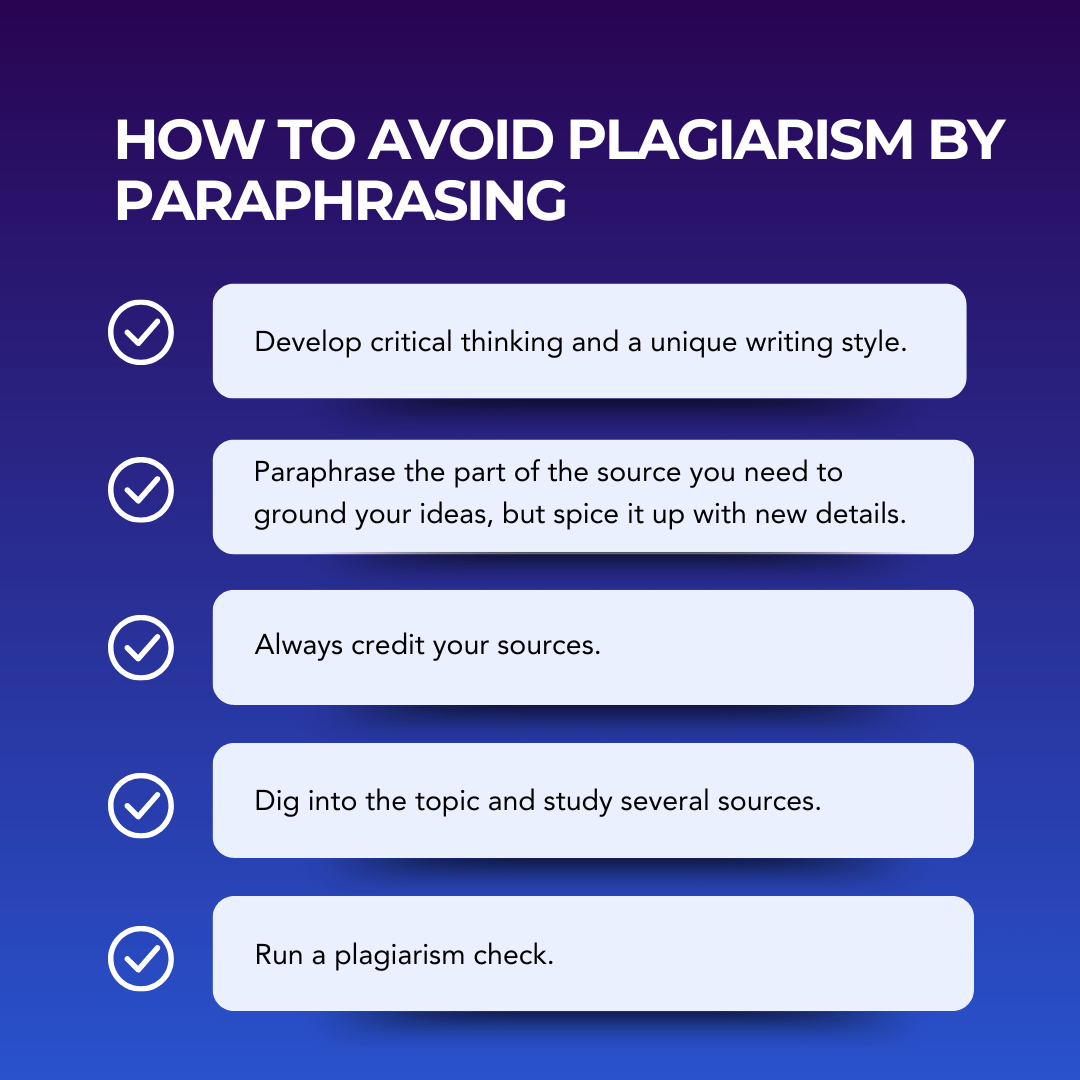
1 Develop critical thinking and a unique writing style. Enhance your paper with original examples, rely on your experience, and strive to find a new angle or approach to the subject. Paraphrase the part of the source you need to ground your ideas, but spice it up with new details.
2 Always credit your sources. Use quotation marks when you provide direct citations, and pay attention to proper attribution. Ensure your sources are relevant and learn to cite correctly. Remember that you can and should attribute the information provided by Chat GPT in academic papers!
3 Dig into the topic. Read several sources, formulate a comprehensive impression, and distill the essence of the subject instead of rewriting a particular text.
4 Run a plagiarism check. Use a reliable tool to catch potential plagiarism and edit the paper before you submit it to the professor.
It’s okay to use shared language. Don’t use quotation marks when writing:
- Commonly-accepted vocabulary
- Conventional designations
- Bias-free language
- Tech-related terms and phrases
Tips on working with the source text
Make lists
You know this safe and proven method from school. When revising a source text, take notes. Paraphrase the source text in your notes. Make a list and use abbreviations. You will define the key insights and nonessential components. This method is effective when you need to analyze, memorize and rewrite a complicated text. It helps to represent your piece of writing in an original manner, starting out from the bottom line. Take handwritten or electronic notes, as you wish. The important thing is to keep notes well-organized. Highlight the important points with bright colors and give subheadings to the pages. And always write down the information source!
Look away from the text when writing
Read the text several times, until you feel ready to retell it. Do not consult the source when writing. Use the abbreviations and lists you’ve made. Write as much as you can looking away from the original text. Don’t refer to a source until you get to the most knotty issue. Consider the research process as a passive learning exercise. Writing tools can also help refine your ideas and improve originality – consider exploring G2’s guide on free writing software. Try to get emotionally involved and outline the most insightful aspects. Then set to writing. Create one bright and unique piece!
So, let’s sum it up. Is it plagiarism if you paraphrase? No, if you do it properly.
How can you be sure you have done a good job? Use a plagiarism detector to highlight the text’s parts requiring more effort and polish your paper.
When to use footnotes to avoid plagiarism
Footnotes serve two primary purposes:
- provide additional information, broader context, commentary, explanation, or any supplemental data that doesn’t fit the main part of the text;
- cite the sources in some styles of academic writing.
Footnotes are primarily required in Chicago-style writing. In some cases, they are also applied in MLA and APA.
- In advertising, footnotes may also provide some legal explanations, for example, containing information about the copyright or license.
- “Note” is the keyword in the “footnote” – it contains some supplemental information, so if the data is crucial, you’d better include it in the main text.
How to make a footnote
In writing, the notion or sentence that needs to be explained in a footnote is marked with a footnote signal. Most often, it is a number (¹) or an asterisk (*). Footnote text is placed at the bottom of the page under the corresponding symbol.
- Within the text, the footnote indicator should follow the notion it relates to – if possible, place it at the end of the sentence after the punctuation mark. The exception is a dash (—), which should be proceeded with the footnote signal.
- The footnote text goes at the bottom of the page under the symbol corresponding to the main body footnote indicator. If there are several notes on one page, they should be placed in the order the notions they explain appear in the text.
- Usually, when there are not many footnotes in the paper, they are marked with asterisks (*). When the writing contains plenty of references, subsequent numbers (¹) are the better choice. The numbering may even be reset at each chapter if the quantity of footnotes is vast.
Footnotes and Chicago citation style
Chicago is the primary citation style that requires footnotes for crediting the sources. Chicago is mainly used for business, history, fine arts, and humanities studies at the graduate level. This citation style includes two systems for source referencing.
Notes and Bibliography
- preferred in humanities — literature, history, and the arts;
- can provide information about the sources that don’t fit into the author-date format (like websites, TV programs, or interviews).
Author-Date
- typical for the sciences and social science;
- includes in-text citations.
In Notes and Bibliography type, endnotes or footnotes can be chosen to provide sources referencing. There are also two ways of citing in Notes and Bibliography format. Let’s consider an example.
Perhaps the most “spiritual” thing any of us can do is simply to look through our own eyes, see with eyes of wholeness, and act with integrity and kindness.¹ – here we see a footnote indicator in the text.
Then, we put the relevant number and a period and provide information about the source. Here, we have two options for citing.
Short citation + Full Bibliography after the main text.
- A short footnote includes the author’s last name, the abbreviated title, and the page numbers.
- 1. Kabat-Zinn, Wherever You Go, There You Are, 40. – short footnote.
Full citation in the footnote without Full Bibliography.
- A full footnote should provide the author’s full name, complete work’s title, information about the publication (city, publisher name, year), and page numbers.
- The short citation form can be used if the same source is cited again.
- 1. Jon Kabat-Zinn, Wherever You Go, There You Are: Mindfulness Meditation in Everyday Life (New York: Hachette Books, 2005), 40. – full footnote
Footnotes in APA citation style
Usually, APA format requires in-text citations in parentheses in the paper’s body. However, there are some cases when footnotes are used for APA writing.
- Content comments and explanations – when the paper’s content requires additional explanation or context that can’t be provided in the main text.
- Copyright attribution – when the paper contains copyright-protected material, for example, visual content that requires referencing.
The citation format for footnotes in APA is similar to the one used in Chicago papers. The difference is that instead of a usual number, we put a superscript without a period in the APA footnote.
¹ The concept of mindfulness was first introduced by Jon Kabat-Zinn in 1991.
Footnotes in MLA citation style
MLA, like APA format, requires in-text referencing. However, we also have some exceptions here when footnotes are preferred over parenthesized explanations.
- When attribution is too long – for example, we are referring to several sources.
- When we refer to non-standard sources that require explanation or providing additional data, like poems’ line numbers.
- When the source we refer to has different versions or translations – it is better to provide information about the particular one in the footnotes.
- When we need to include some extra information that doesn’t fit the text.
MLA footnote format is similar to the one used in APA-style papers.
PlagiarismCheck.org is here to help! Try it for free to check your paraphrasing skills, use AI checker GPT, and empower your writing.