
Accurate AI detector for Turnitin – New Release
One of the most common solutions academic institutions use to check papers for plagiarism is Turnitin. This platform has overtaken family-rooted Unicheck, PlagScan, and many other smaller tools that used to operate independently. However, each solution has its own set of advantages and disadvantages, which we discussed in our comparative article, “Top 5 Plagiarism Checkers for Students and Teachers in 2024”.
In response to the rapid development of AI writing, Turnitin launched Turnitin AI detector, that is able to detect the presence of AI writing with about a one percent false-positive rate. However, Turnitin AI detection is not the only option available.
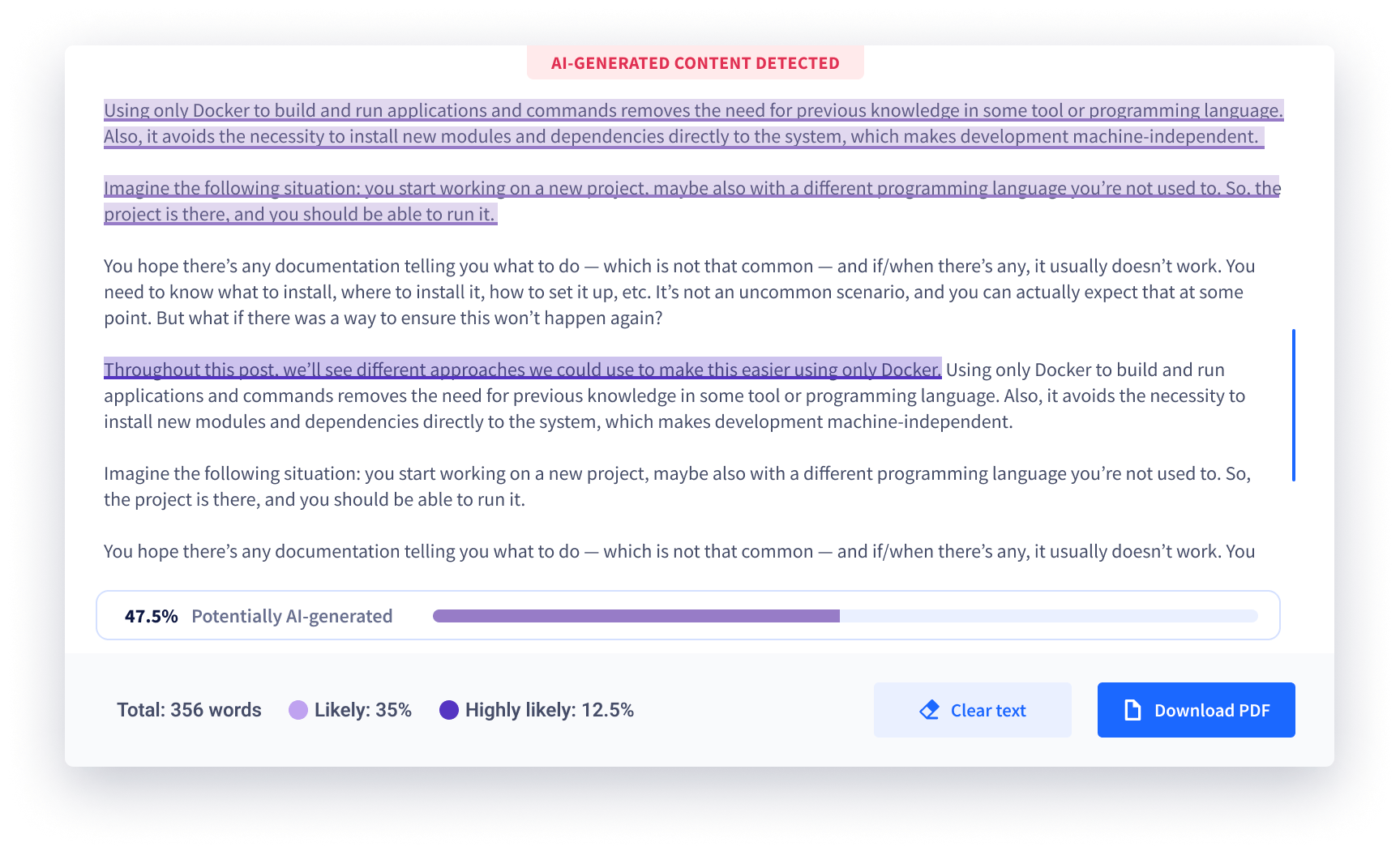
Even if you use Turnitin to check for plagiarism and implement an AI proofreader to perfect your writing, but want a convenient, innovative solution for the high-quality identification of AI-generated texts, you can try PlagiarismCheck.org:
- It’s a leading tool that has been used by thousands of institutions for more than eight years;
- PlagiarismCheck’s latest features demonstrate extremely high AI writing detection capabilities and unique opportunities;
- Its effectiveness is confirmed by high accuracy and a low percentage of false positives;
- PlagiarismCheck.org uses several unique author models to detect signs of text written by artificial intelligence, including perplexity detection, and is constantly updated;
- Students can pre-check their texts as individual users, and use additional tools to foster writing skills.
The AI Plagiarism Checker & Chat GPT Content Detector is an alternative to Turnitin AI detector and is part of the comprehensive PlagiarismCheck.org solution for plagiarism checking and improvement. One can implement AI detector as part of PlagiarismCheck.org toolkit or as a separate instrument.
Is GPT 4 detectable?
The education sector is particularly concerned about the advent of ChatGPT, as it raises questions about students’ originality in essays. How can teachers determine whether a student has expressed their own thoughts or if ChatGPT has written everything for them? To save teachers and lecturers from spending excessive time checking for plagiarism and to discourage student cheating, educational institutions utilize reliable GPT 4 detector. One such detector is TraceGPT by PlagiarismCheck, which can distinguish between sentences written by humans and those that show clear signs of GPT, including the most recent release.
How does GPT-4.5 compare to GPT-4 in terms of capabilities
Chat GPT-4.5 is a step towards upgrading the model’s soft skills.
- While characteristics like creativity, emotional intelligence, and intuition are hard to measure, GPT-4.5 shows better results with tasks in writing, coding, languages, and design, demonstrating less effective performance in maths and sciences.
- The new model predicts and understands human emotions and interactions better, which allows AI to interpret the prompts more accurately, guaranteeing higher emotional intelligence and relevancy.
- Chat GPT-4.5 is not a universal solution and cannot be considered the most advanced model for all tasks. It is supposed that in the future, the system will be able to select the best GPT model depending on the user’s request, switching between them to tailor the model’s capabilities to the user’s needs. Meanwhile, the best we can do is learning about different models’ particularities, and choose the one that matches our requests the most.
The impact of AI in education and beyond: verifying Human vs. ChatGPT authors
Universities and businesses are now actively working on policies for using artificial intelligence. To avoid creating rules mindlessly, it is worth clearly understanding how and so reliably we can check whether the text was written by a person or ChatGPT (or another AI model).
If ChatGPT generated the text, but a person passes it off as an author, this is ChatGPT plagiarism. There are certain risks in using text generated by artificial intelligence models: from getting into the content of unverified, false information to reputational challenges due to non-author content.
The concept of AI plagiarism or AIgirism has another meaning. It is understood not only that the AI’s text is passed off as its own, but also in cases where the AI generates plagiarism or paraphrase of already existing content instead of creating unique texts. We discussed incidents when the AI model did not cite sources in the article “Google AI chatbot Bard generated to 45% of plagiarism: PlagiarismCheck’s research”.
How to check AI plagiarism?
Special software – AI detectors – allows us to determine whether a person or AI wrote the text. Thanks to unique algorithms for analyzing signs of human and AI writing, it is possible to establish the text’s origin. To get a reliable result in a few clicks, you can use PlagiarismCheck.Org.
This solution allows you to get a result with 97% accuracy and can be easily integrated into your system. Our team of leading experts, including computational linguists, natural language processing specialists, and machine learning engineers, has been working on research and development to identify non-author texts for many years.
While educators still develop the rules and standards of acceptable AI involvement, it is evident that machine-generated assignments contradict the very idea of acquiring education, gaining new skills, and cultivating an original mindset. Moreover, using ChatGPT and other AI-generating tools can jeopardize your reputation and cause plagiarism-related issues.
Wait, does ChatGPT plagiarize? Well, the answer may sound a bit tricky.
Technically, ChatGPT and other AI-based tools do not copy the text word-for-word. So, comparing the sources, one won’t find the exact writing passage in your work. However, plagiarism goes far beyond writing verbatim. From this perspective, AI does appropriate people’s works.
Even more, when teachers check AI-generated content for plagiarism, the plagiarism and AI detection tools highlight alleged copying and ChatGPT traces in the papers.
Is AI detection always accurate?
The answer is no. As any tool, AI detector can be mistaken. It shows the extent to which the submitted content matches the patterns detector knows as characteristic of AI-generated text. However, the final judgement is always up to the human expert. Here are some tips to help you analyze the AI detection report.
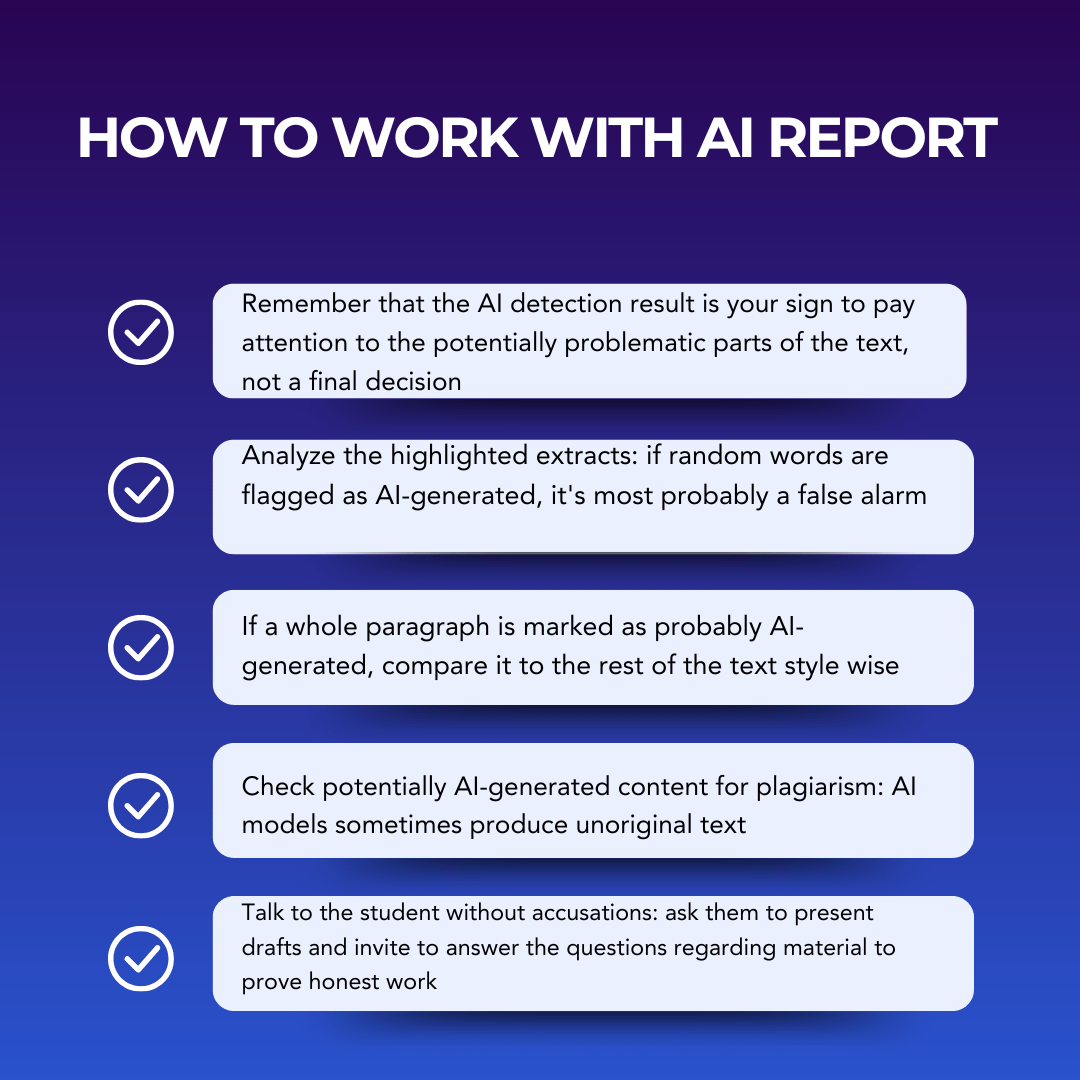
The role of AI detectors in identifying ChatGPT plagiarism and ensuring authenticity
AI detector is used in various industries in addition to education:
- Moderators of content platforms to remove fake product reviews or other AI-generated spam;
- Media editors and publishing houses to ensure the reliability and authorship of materials;
- Marketing agencies to ensure the highest quality of creative projects and their uniqueness.
Get the newest, original, and comprehensive full-fledged plagiarism tool and Chat GPT checker with excellent results in just two clicks.