
- Overview
- Account guides
- Blackboard
- Brightspace
- Canvas
- Google Classroom
- Moodle
- Administrator’s Guide – How to connect PlagiarismCheck with Moodle via plugin
- Guía del administrador: cómo integrar PlagiarismCheck con Moodle mediante el plugin
- Guía para profesores
- Instructor’s guide — How to use an integration
- Administrator’s Guide – How to connect PlagiarismCheck with Moodle LTI 1.3 (Dynamic Registration)
- Administrator’s Guide – How to connect PlagiarismCheck with Moodle LTI 1.3 (Manual Registration)
- Schoology
Administrator’s Guide – How to connect PlagiarismCheck with Moodle LTI 1.3 (Manual Registration)
This guide walks Moodle administrators through enabling the PlagiarismCheck.org LTI 1.3 integration using manual registration. Once enabled, instructors can attach PlagiarismCheck to any assignment, students submit their work directly inside Moodle, and originality reports plus grades flow back automatically.
Before you start
You’ll need:
- Administrator access to your Moodle instance.
- An active PlagiarismCheck.org organisation account with Admin (Owner) role. If you don’t have Admin access, but you need it, please contact us here.
- The registration page on plagiarismcheck.org open in another tab — you’ll use it to generate the registration URL and to receive the platform details Moodle gives you back.
Note: Use manual registration when your institution blocks outbound dynamic registration, or when you prefer to review each setting yourself. The process exchanges configuration in two directions: PlagiarismCheck → Moodle, then Moodle → PlagiarismCheck.
Step 1: Navigate to Integrations
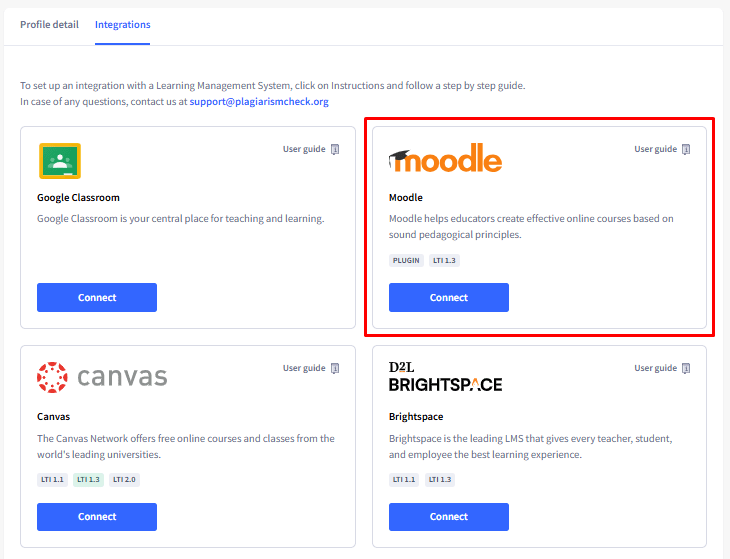
- Login to PlagiarismCheck and follow Profile → Integrations or just click on this link https://plagiarismcheck.org/profile/integrations-list. On the list of integrations scroll until you see Moodle.
Step 2: Access your registration URLs
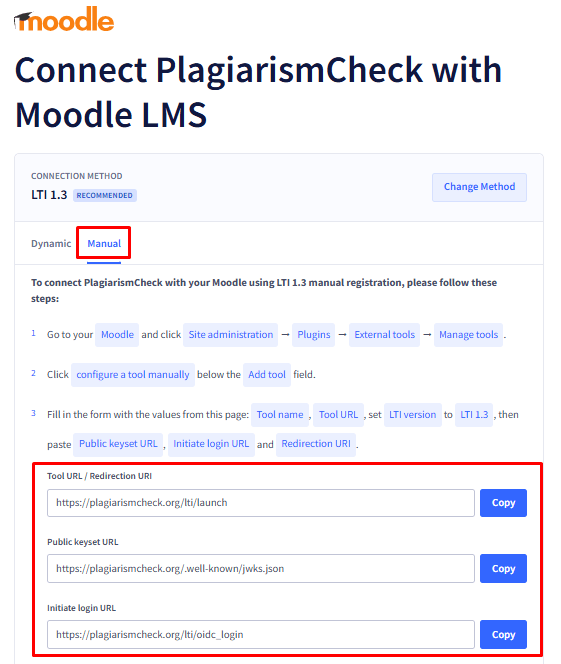
- On the PlagiarismCheck registration page, select Manual tab, scroll to Tool URL/Redirection URL, Initiate login URL, Public Keyset URL and then Copy.
Step 3: Open Moodle’s manual configuration form
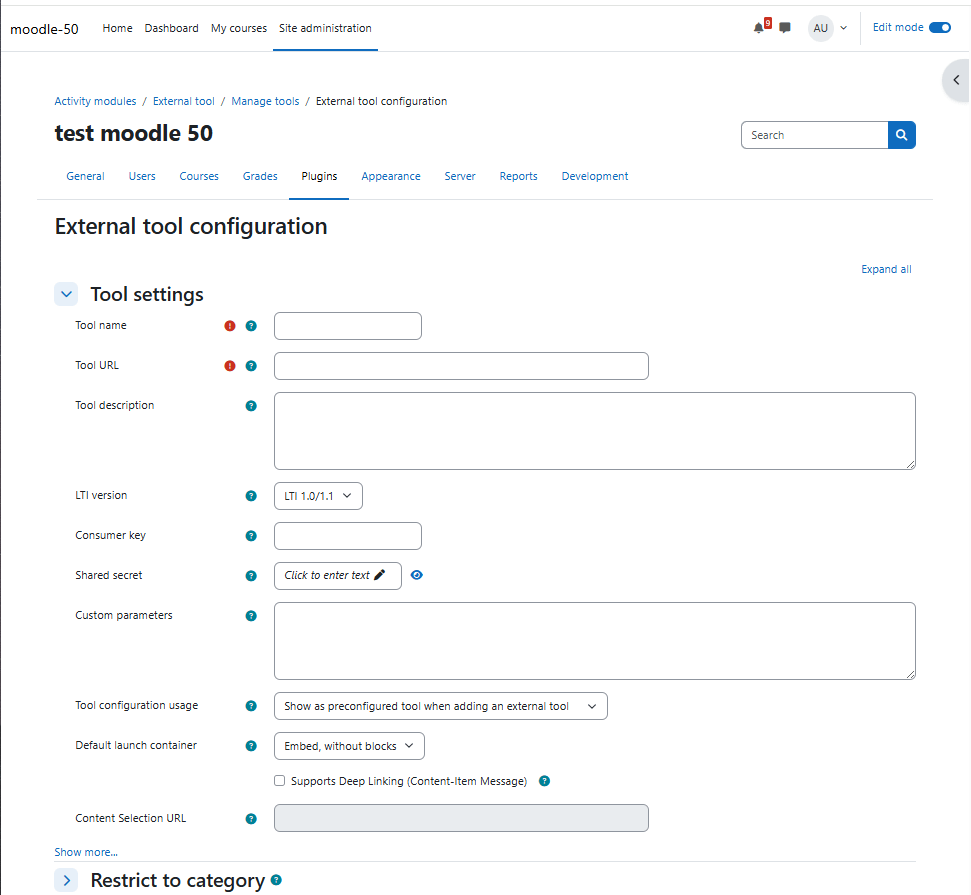
- Sign in to Moodle as a site administrator. Go to Site administration → Plugins → External tools → Manage tools . In the Add tool panel click the small configure a tool manually link beneath the URL field. Moodle opens the External tool configuration form.
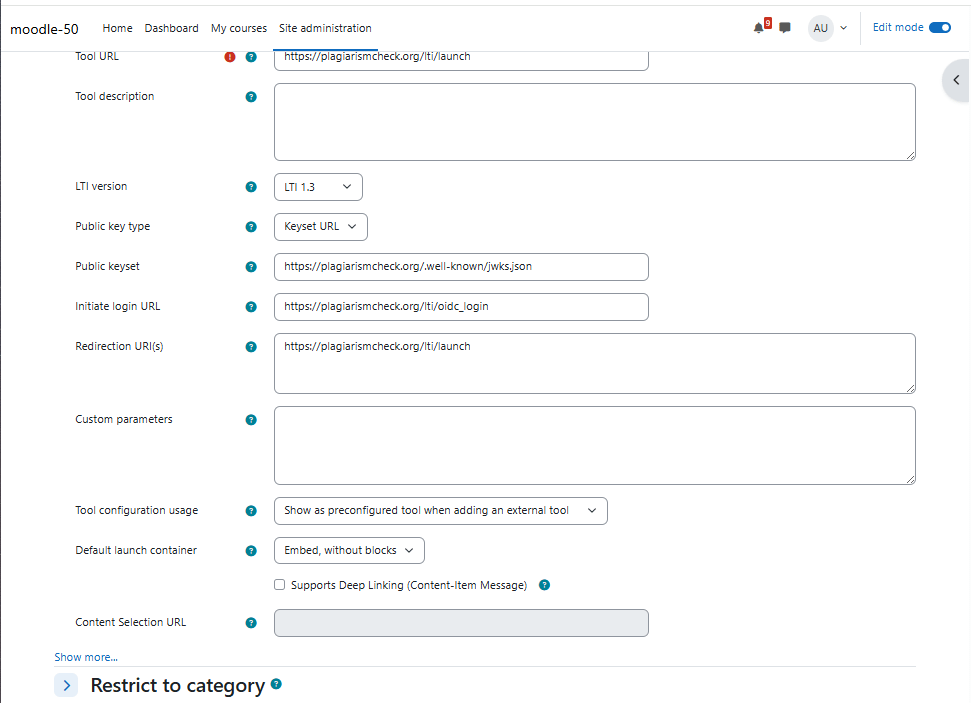
Step 4: Fill in the basic fields
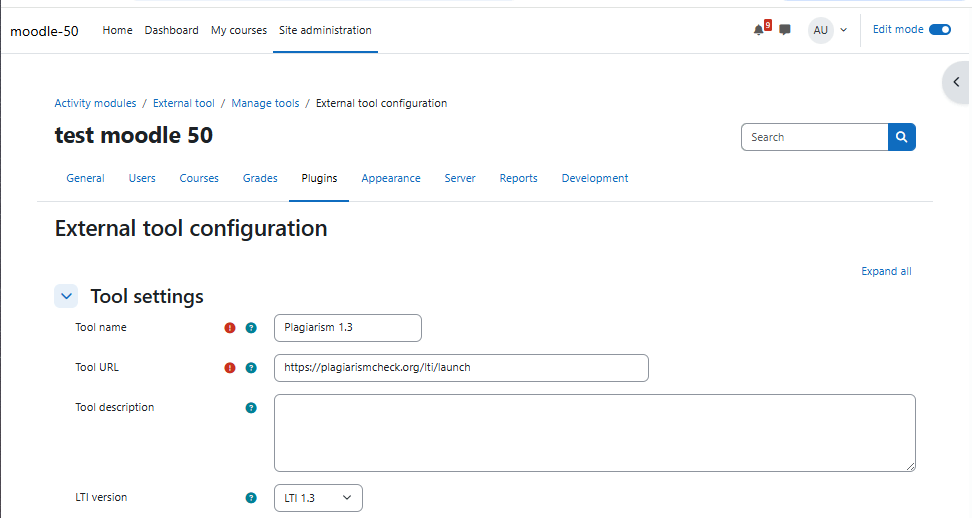
- Copy the values shown on the PlagiarismCheck registration page (Step 2 of this guide) into the matching fields:
- Tool name — anything you like, e.g. ‘PlagiarismCheck LTI 1.3′.
- Tool URL — copy the Tool URL value.
- LTI version — choose LTI 1.3 . The form expands with extra fields.
Step 5: Fill in the LTI 1.3 fields
- Once LTI 1.3 is selected, four more fields appear. Copy each value from the PlagiarismCheck page (Step 2 of this guide):
- Public key type — Keyset URL .
- Public keyset — copy the Public Keyset URL.
- Initiate login URL — copy the Initiate login URL.
- Redirection URI(s) — copy the Redirection URL.
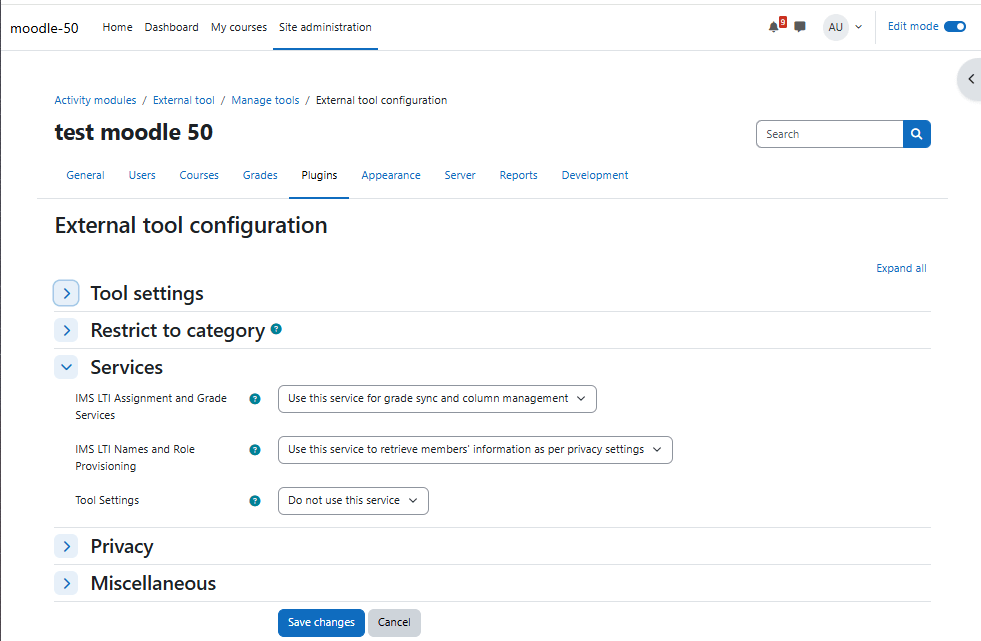
Step 6: Enable LTI Advantage services
- Expand the Services section and set:
- IMS LTI Assignment and Grade Services — Use this service for grade sync and column management .
- IMS LTI Names and Role Provisioning — Use this service to retrieve members’ information as per privacy settings .
- Tool Settings — leave as Do not use this service .
Step 7: Enable LTI Advantage privacy settings
- Expand the Privacy section and set:
- Share launcher’s name with tool – Always.
- Share launcher’s email with tool – Always.
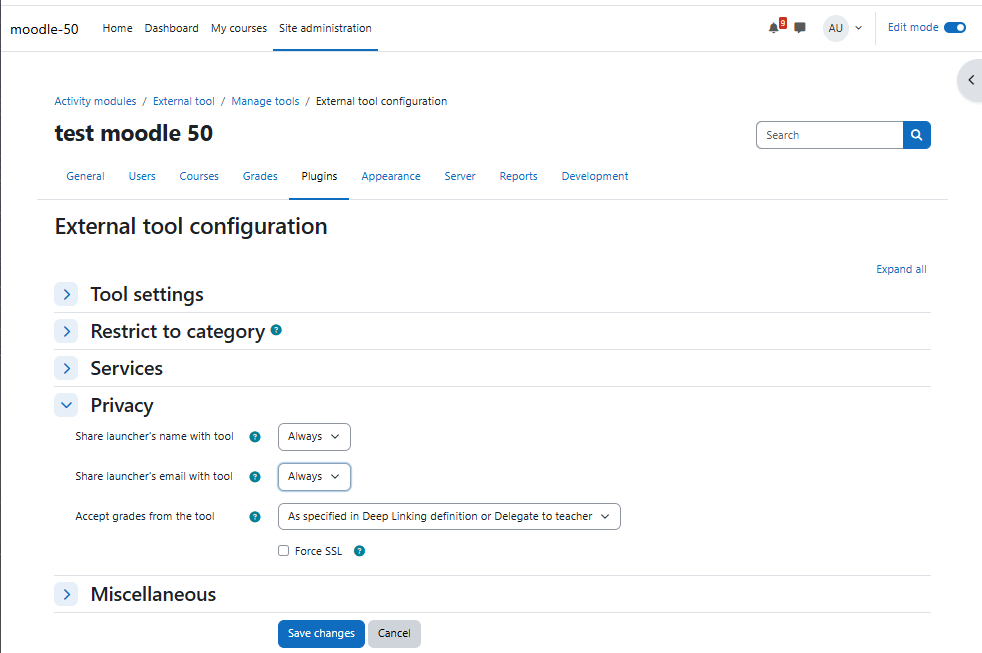
Note: Without these services enabled, grades and originality results won’t sync back to Moodle’s gradebook.
Step 8: Save and copy Moodle’s platform details
- Scroll to the bottom and click Save changes . The new tool appears in the Tools list. Hover the card and click the View configuration details icon (the small magnifier).
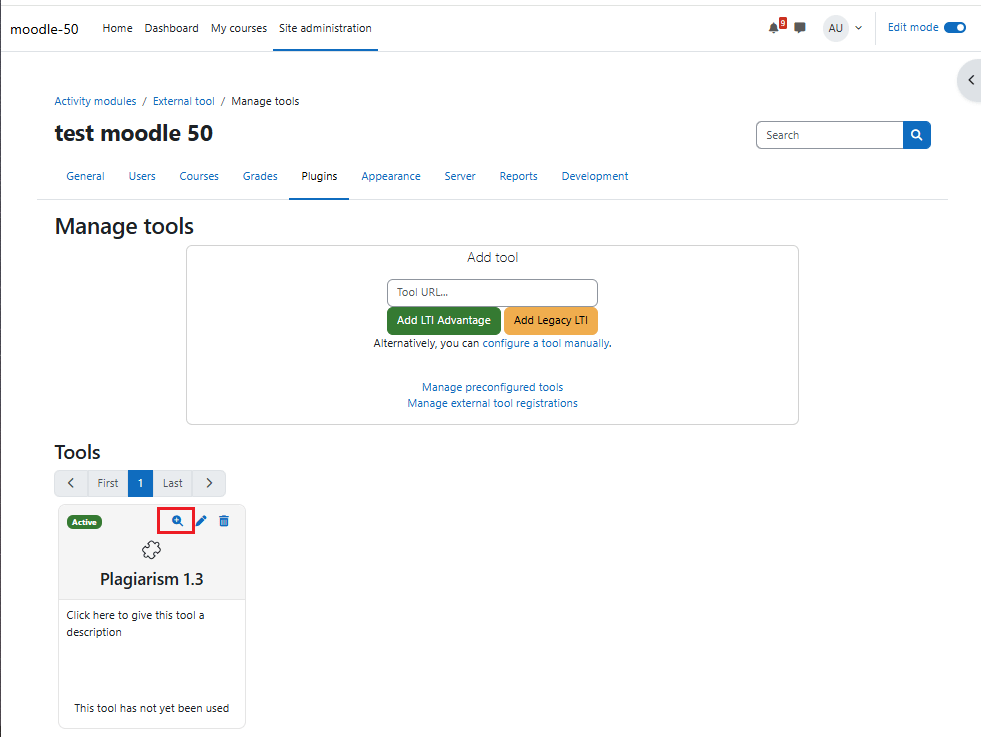
- Moodle displays a Tool configuration details dialog. Copy each of these into the corresponding field on the PlagiarismCheck manual registration page:
- Platform ID
- Client ID
- Deployment ID
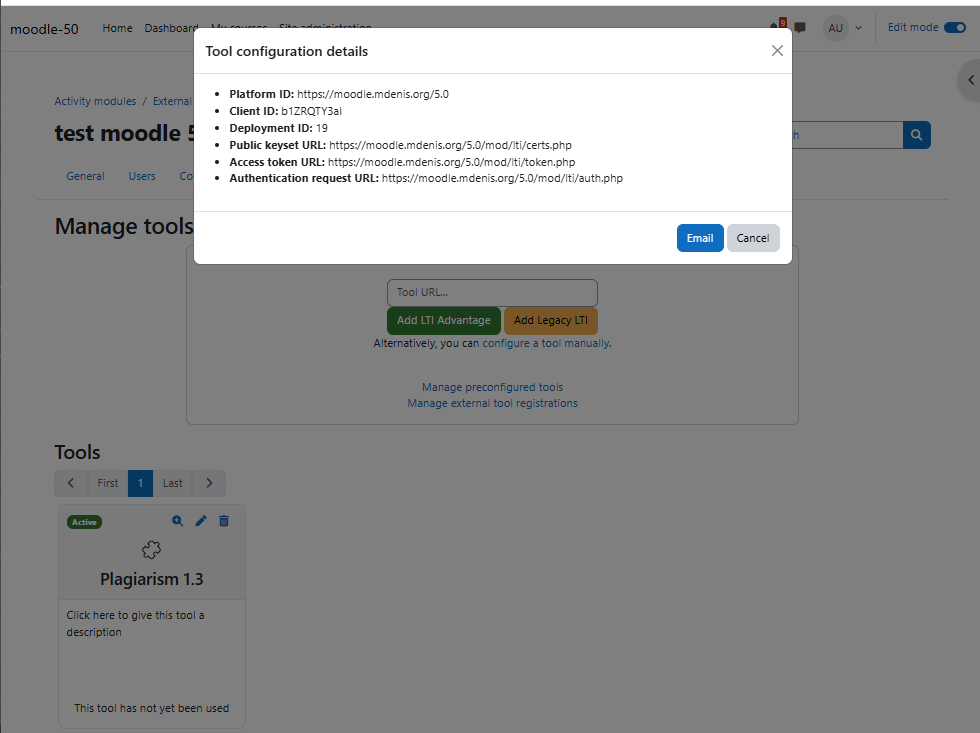
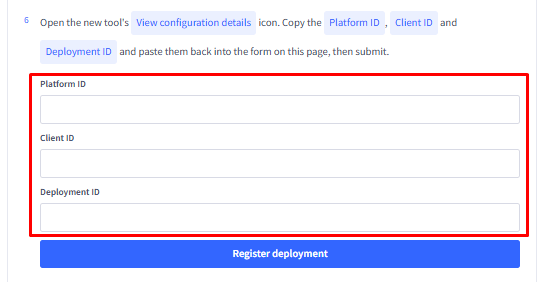
- Click Register deployment and PlagiarismCheck creates the deployment on its side and your tool is ready to use.
Testing the integration
After registration, switch to a test course and create an assignment that uses PlagiarismCheck as its external tool. Submit a short sample document as a student, return as the instructor, and confirm that the originality report opens and the grade syncs back to the gradebook.
Troubleshooting
Tool stays Pending and never activates
Reopen the registration page in another tab and check that the URL you pasted into Moodle hasn’t expired. Registration URLs are single-use; generate a new one and repeat the registration step.
Originality reports don’t appear in the gradebook
Confirm that Assignment and Grade Services and Names and Roles Provisioning are enabled on the tool. In Moodle, verify the assignment was created with PlagiarismCheck as the submission type.
Students see an error when launching the tool
Ask the student to clear cookies for your LMS domain and retry. If the error persists, copy the error code from the launch screen and contact support@plagiarismcheck.org.
Need help?
Email support@plagiarismcheck.org — please include your institution name, the LMS version, and a screenshot of any error you see.