

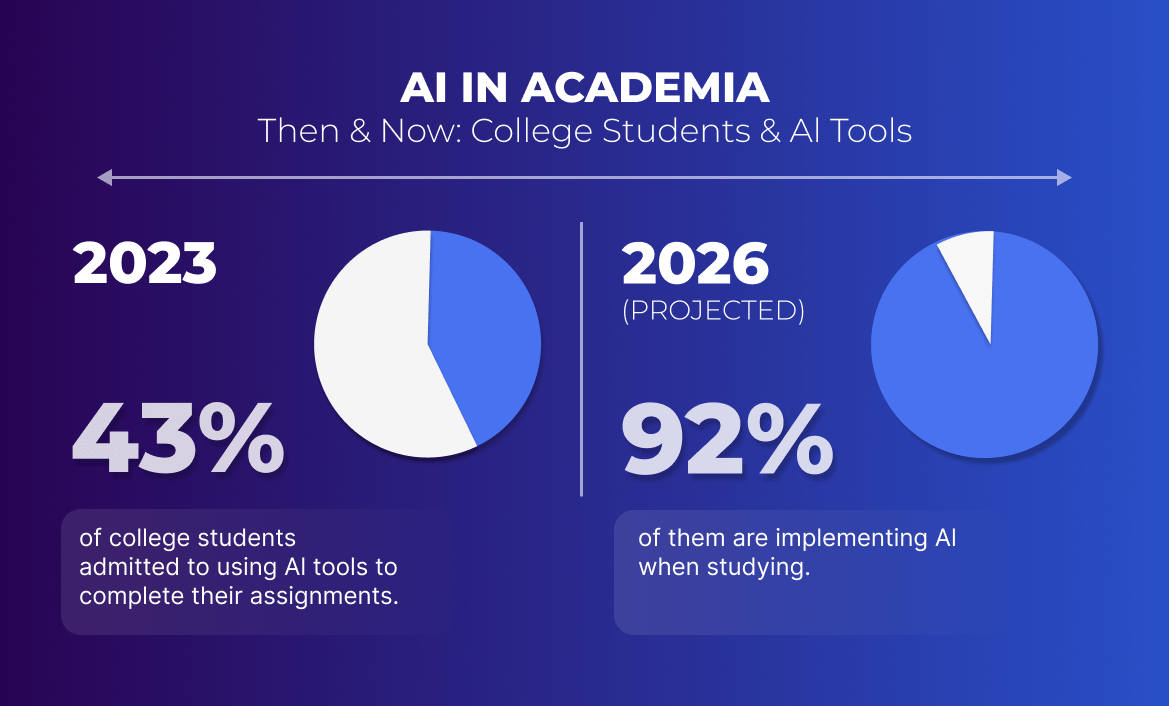
In 2023, 43% of college students admitted to using AI tools to complete their assignments. In 2026, 92% of them are implementing AI when studying. Does it mean all of them can be accused of academic cheating?
Not necessarily, states Anson Alexander in his 2026 research.
According to the published data, only 18% of students use AI tools to complete tasks for them. What about the rest of the group?
The poll shows that 89% of the students who implement AI in their workflow use ChatGPT or similar chatbots for homework tasks, 53% for essays, and 48% for at-home tests.
“Implementing AI”, however, has a broad range of contexts, from brainstorming and asking the chatbot to explain the material to editing the text before submission. The line between using AI as a helpful modern tool and AI misuse, called academic cheating, is blurry and depends on each institution, if not the teacher.
The numbers show that 58% of students claim to use AI as an online tutor rather than to cheat the system. 48% implement it for research, and 38% for brainstorming. 51% of them recognize that using ChatGPT for assignments is cheating, but 22% still do.
At the same time, when it comes to the obvious AI abuse, which is the student submitting an AI-produced assignment without working on it, only 17% of papers in the US educational institutions, and about 16% of papers in Canadian schools, are generated by AI. Why “only”?
The research reveals that if we take completely AI-generated works as a cheating benchmark, the number of students trying to trick the system hasn’t changed much. “In 2012, 17% of students used phones to text answers. In 2026, 18% use AI to submit unedited work,” states the article.
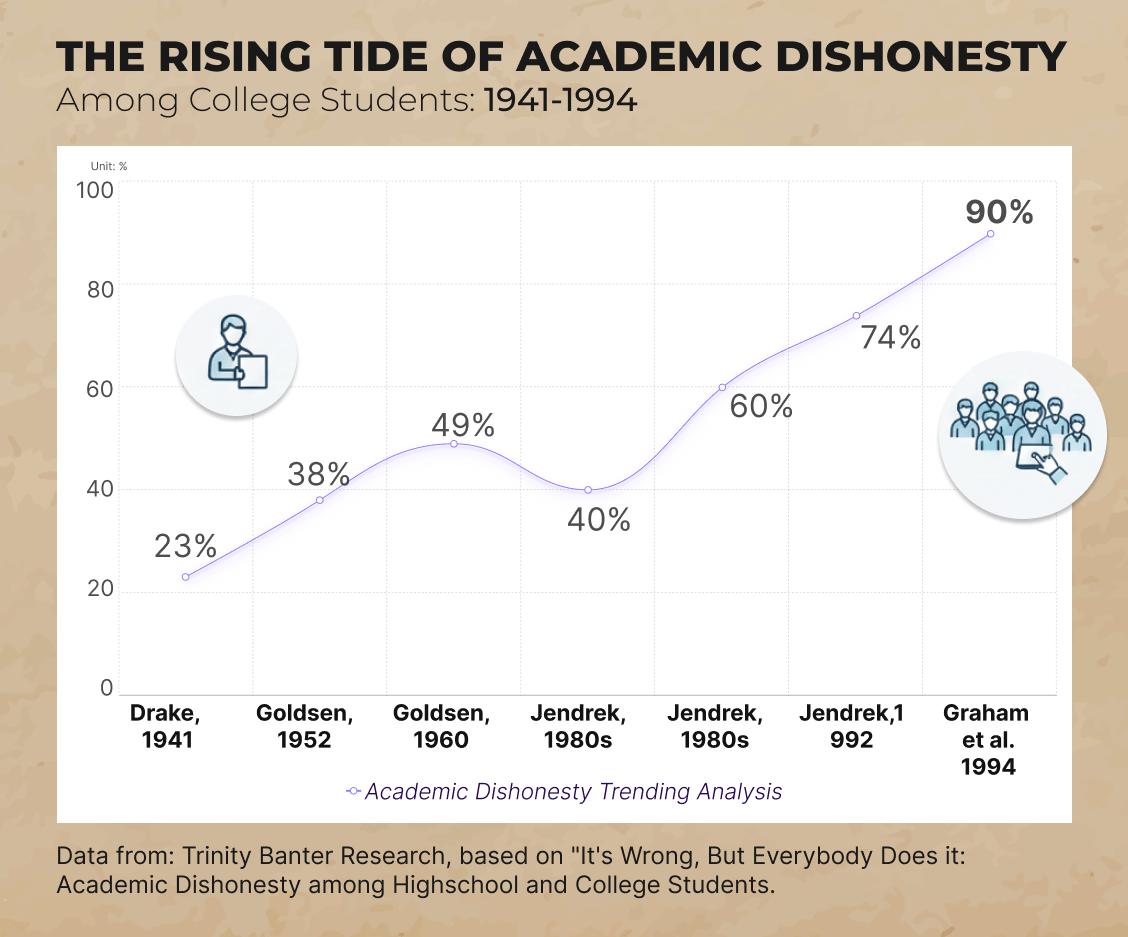
At the same time, Trinity Banter research cites statistics from the study’s literature review, “It’s Wrong, But Everybody Does it: Academic Dishonesty among High School and College Students,” claiming that academic cheating has increased drastically over the years.
“In 1941, Drake found that 23% of college students reported cheating. Goldsen (1960) reported rates of 38% in 1952 and 49% in 1960. By the 1980s, Jendrek (1989) estimated the typical rate between 40 and 60%. By 1992, she found that 74% of college students engaged in cheating (Jendrek, 1992). Even more recently, researchers have reported rates as high as 90% (Graham, Monday, O’Brien, and Steffen, 1994). These rates pertain to college students.” By academic cheating, the study considers any form of dishonesty, including ‘cheating,’ ‘fraud,’ and ‘plagiarism,’ the theft of ideas and other forms of intellectual property, whether they are published or not.”
As we see, the perspective and numbers strongly depend on what one defines as cheating.
Meanwhile, 50% of college students believe that educational institutions should check the assignments for AI to avoid inequality. At the same time, 42% of students would not trust the admission offices to make decisions based on AI tools.
90% of the students are sure they will not be caught in academic dishonesty. The research conducted by ETS and the Ad Council proves them right: 95% of students cheating when crafting their assignments are not caught.
Roughly 85% of the surveyed students confess that they started cheating in high school. The tendency proves the pivotal role of establishing writing and studying ethics from an early age, since students who start cheating at school continue it at college and even influence younger learners in elementary classes. Moreover, in the first study year, 59% of students admitted to cheating. In the second, the number in the same group reached 95%.
85% of the students who admitted to cheating believed it was essential. However, most of them were not led by a malicious plan: among the popular reasons for cheating were the learners’ lack of time, fear of failure, anxiety, or other mental health struggles.
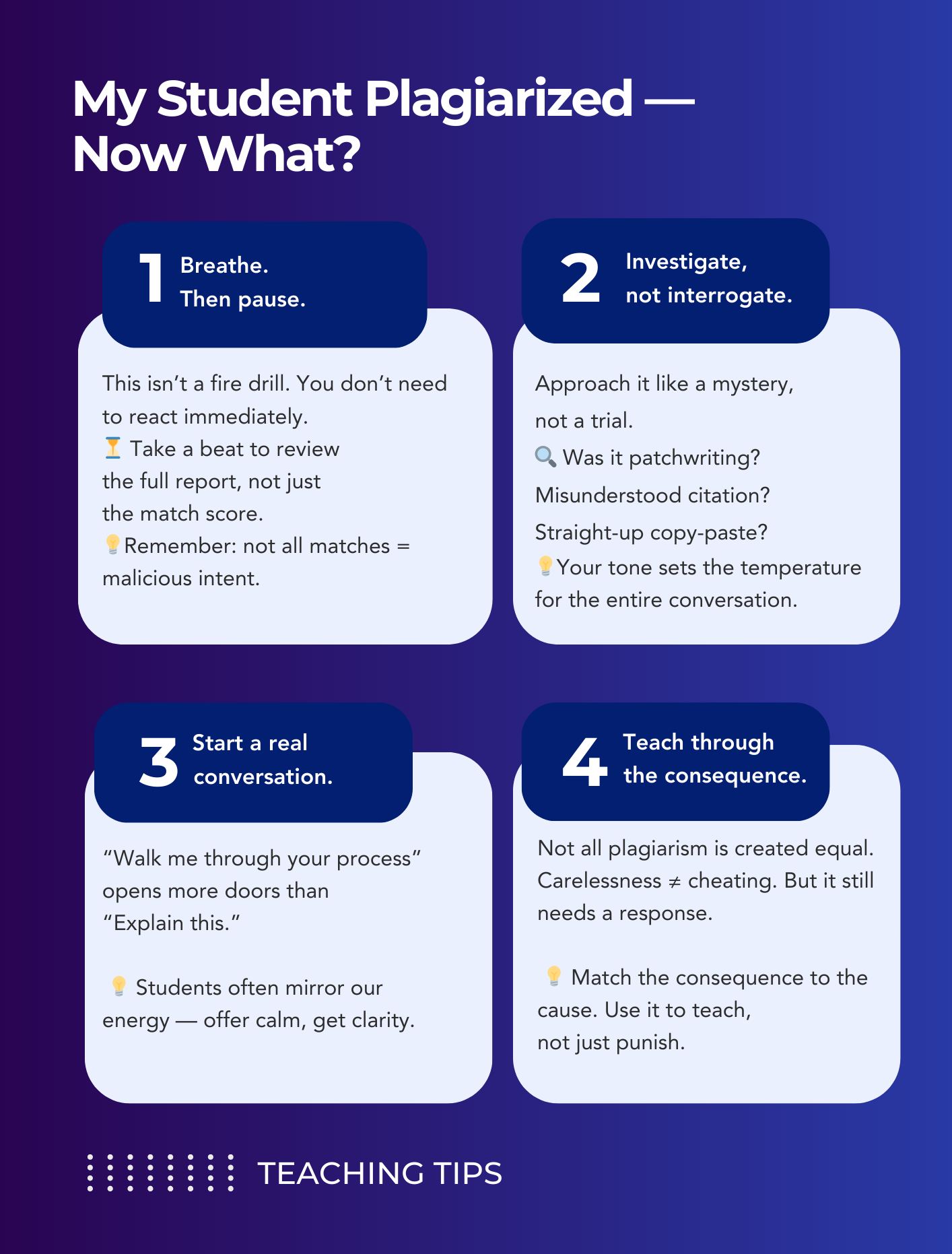
Whatever the reasons are, for every cheating attempt, there are ways and tools to empower educators in their battle for academic honesty and equal opportunities for all students. Here are some of them.
- Educating the students on academic integrity and implementing the honor code. The more students are aware of the problem and the consequences of cheating, the less likely they are to break the rules.
- Giving the students clear instructions and enough time for the assignments. Transparent guidelines are the key, especially when it comes to controversial subjects like ChatGPT. Students should know that the work is expected to be original and authentic.
- Using tools to check for plagiarism, contract cheating, ghostwriting, and AI. Instead of wasting time and effort on checking the robot-written assignments or trying to distinguish between original and plagiarized work, teachers can make this process effortless and automatic, focusing on educating their learners and helping them grow. PlagiarismCheck.org is committed to academic integrity and offers a comprehensive toolkit covering both teachers’ and students’ needs.