

![Plagiarism Rate by Country [Updated March 2026]](https://plagiarismcheck.org/blog/wp-content/uploads/2026/05/plagiarismcheck.org_students_writing_a_task_-ar_9151_-sref__388e6625-2bb6-4005-b159-68b782c3dae7_0.png)
Understanding how often plagiarism occurs across different countries has become increasingly important as academic and digital content production continues to grow worldwide. Recent plagiarism statistics reveal that the percentage of plagiarism varies significantly between regions, institutions, and submission environments. These differences highlight how the rate of plagiarism can change depending on educational systems, digital access, and academic integrity policies.
In this report, we analyze global plagiarism rates using data collected between 2018 and 2024. The dataset provides insight into how the percentage of plagiarism has evolved and how the rate of plagiarism differs across countries. By examining both long-term trends and country-level comparisons, the analysis offers a clearer view of global plagiarism by country and the scale of variation in plagiarism rates.
The following sections present a detailed breakdown of global trends, regional comparisons, and the countries with the highest and lowest plagiarism rates. These plagiarism statistics illustrate where the percentage of plagiarism is higher or lower and how the global rate of plagiarism has changed over time.
Global plagiarism statistics show significant variation in the percentage of plagiarism across countries. The highest plagiarism rate in 2024 reached 29.5%, while the lowest recorded rate was 2.6%, indicating a difference of more than 26 percentage points.
Before examining plagiarism by country, it is useful to review the global trend in plagiarism rates over time.
Global plagiarism rates over time (2018-2024)
The chart below presents global plagiarism statistics showing how the percentage of plagiarism has changed annually between 2018 and 2024. These figures illustrate how the overall rate of plagiarism has evolved. Understanding this global trend provides context for later analysis of plagiarism by country and differences in plagiarism rates across regions.
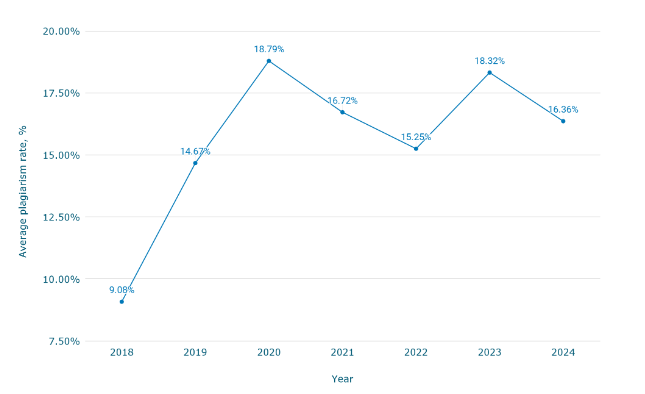
- The global percentage of plagiarism increased from 9.08% in 2018 to 14.67% in 2019, representing the largest year-over-year increase in the dataset.
- The rate of plagiarism reached its peak at 18.79% in 2020 before declining to 16.72% in 2021.
- After decreasing to 15.25% in 2022, global plagiarism rates rose again to 18.32% in 2023 before settling at 16.36% in 2024.
Global plagiarism statistics by year (2018-2024)
Overall, plagiarism statistics show a clear increase in the global percentage of plagiarism compared with the beginning of the observed period. Although the rate of plagiarism fluctuated after 2020, the values in later years remained substantially higher than in 2018. This upward shift indicates that global plagiarism rates have stabilized at a higher level, providing important context for analyzing patterns of plagiarism by country in subsequent sections.
After examining the overall trend in global plagiarism statistics, the next step is to compare plagiarism by country and observe how the rate of plagiarism varies across different regions.
Plagiarism by country: Global comparison of plagiarism rates in 2024
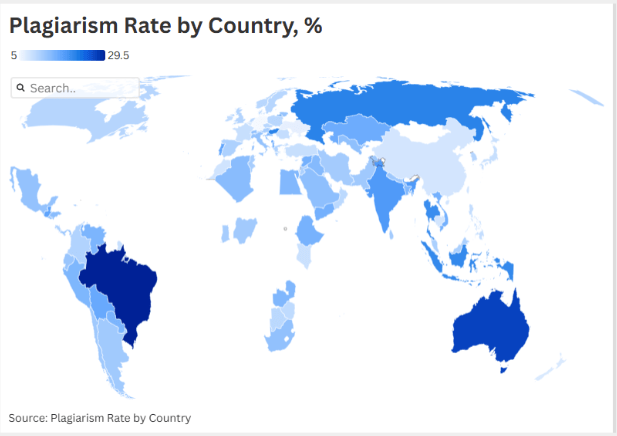
The chart below presents plagiarism statistics showing the percentage of plagiarism detected across countries in 2024. These data provide a global overview of plagiarism by country, highlighting how plagiarism rates differ significantly between nations. By comparing the rate of plagiarism across countries, the dataset helps identify geographic patterns and areas where the percentage of plagiarism is relatively high or low. Such comparisons provide a clearer understanding of the global distribution of plagiarism rates.
Source: https://app.flourish.studio/visualisation/27981411/
- The highest percentage of plagiarism in 2024 was recorded in Brazil at 29.5%, followed by the United States at 26.9% and Australia at 26.8%.
- Several countries show plagiarism rates above 20%, including Bahrain (24.3%), Hungary (21.1%), Russia (21.0%), and Indonesia (20.3%).
- The lowest rate of plagiarism in the dataset appears in Bosnia and Herzegovina at 2.6%, while Germany recorded 5.0% and Hong Kong 5.2%.
Overall, plagiarism statistics demonstrate substantial variation in the percentage of plagiarism between countries. While several countries report plagiarism rates above 20%, many others show considerably lower values below 10%. These differences suggest that the rate of plagiarism is influenced by multiple regional factors such as educational practices, digital access, and academic integrity policies. Examining plagiarism by country provides context for understanding how plagiarism rates differ globally.
While the previous chart compared plagiarism rates across all countries, the next visualization highlights the countries with the highest percentage of plagiarism in 2024.
Top 20 countries with the highest plagiarism rates in 2024
The chart below focuses on the top countries with the highest plagiarism rates in 2024. These plagiarism statistics identify the locations where the rate of plagiarism is most pronounced, providing a clearer view of the upper range of global plagiarism by country. By examining the countries with the highest percentage of plagiarism, the dataset reveals which regions contribute most to the global distribution of plagiarism rates.
Plagiarism rate
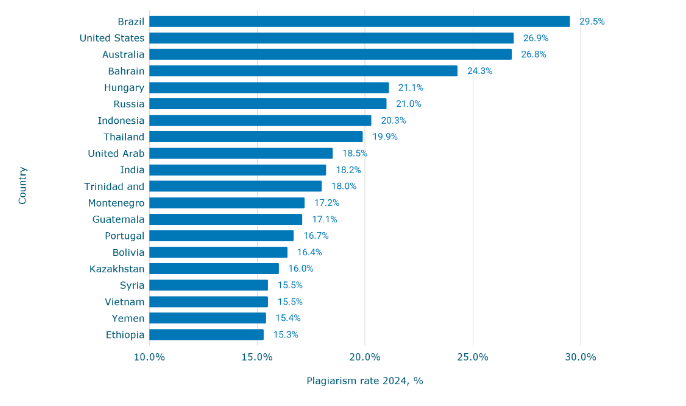
- Brazil leads the ranking with a plagiarism rate of 29.5%, followed by the United States (26.9%) and Australia (26.8%).
- Several countries show plagiarism rates above 20%, including Bahrain (24.3%), Hungary (21.1%), Russia (21.0%), and Indonesia (20.3%).
- The lowest values within the top twenty countries remain above 15%, including Syria and Vietnam at 15.5%, Yemen at 15.4%, and Ethiopia at 15.3%.
Countries with the highest percentage of plagiarism in 2024
These plagiarism statistics show that the highest percentage of plagiarism in 2024 is concentrated in a relatively small group of countries. Many of the countries in the top twenty display plagiarism rates between 15% and 30%, indicating a significant range in the global rate of plagiarism. Analyzing these results alongside broader data on plagiarism by country helps clarify where the upper boundary of global plagiarism rates occurs and how the percentage of plagiarism compares among the highest-ranking countries.
Beyond identifying the countries with the highest plagiarism rates, it is also important to examine where the rate of plagiarism has grown the most over time.
Countries with the largest growth in plagiarism rates (2018-2024)
The chart below highlights countries that recorded the largest increase in the percentage of plagiarism between 2018 and 2024. These plagiarism statistics provide insight into how plagiarism rates have changed over time across different regions. By comparing the rate of plagiarism at the beginning and end of the period, the dataset reveals where the most significant growth in plagiarism by country has occurred.
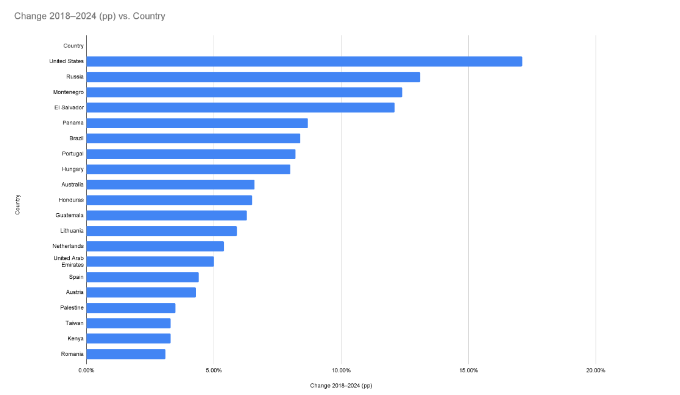
- The United States recorded the largest increase in the rate of plagiarism, rising from 9.8% in 2018 to 26.9% in 2024, a change of 17.1 percentage points.
- Russia showed the second-largest growth in plagiarism rates, increasing from 7.9% in 2018 to 21.0% in 2024, representing a rise of 13.1 percentage points.
- Several countries experienced increases above 10 percentage points, including Montenegro (4.8% to 17.2%) and El Salvador (2.1% to 14.2%).
Countries with the fastest increase in the rate of plagiarism (2018-2024)
These plagiarism statistics indicate that the percentage of plagiarism has increased significantly in several countries over the observed period. In multiple cases, the rate of plagiarism more than doubled between 2018 and 2024. The growth patterns highlight how plagiarism rates can change rapidly over time and reinforce the importance of examining trends in plagiarism by country rather than relying solely on single-year comparisons.
While some countries record relatively high plagiarism rates, it is equally important to examine where the rate of plagiarism remains comparatively low.
Countries with the lowest plagiarism rate in 2024
The chart below presents countries with the lowest percentage of plagiarism recorded in 2024. These plagiarism statistics highlight regions where plagiarism rates remain significantly below the global averages observed in previous sections. By comparing the rate of plagiarism across these countries, the dataset provides additional context for understanding global patterns in plagiarism by country.
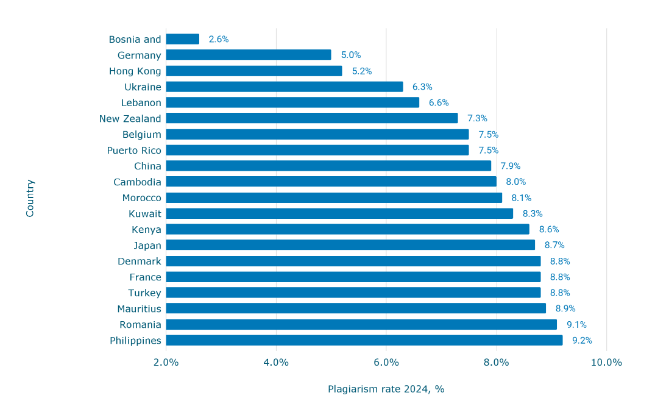
- Bosnia and Herzegovina recorded the lowest percentage of plagiarism at 2.6%, representing the smallest value among all countries in the dataset.
- Several countries reported plagiarism rates below 6%, including Germany at 5.0% and Hong Kong at 5.2%.
- A number of countries show plagiarism rates between 7% and 9%, including China at 7.9%, Japan at 8.7%, and France at 8.8%.
Countries with the lowest percentage of plagiarism in 2024
These plagiarism statistics demonstrate that the percentage of plagiarism varies widely across countries. In contrast to countries with high values observed earlier, the countries in this group report plagiarism rates below 10%. This variation indicates that the rate of plagiarism can differ substantially depending on national academic practices and digital submission environments. Examining both the highest and lowest values in plagiarism by country provides a more complete understanding of global plagiarism patterns.
Conclusions
- The available plagiarism statistics indicate that the global rate of plagiarism increased significantly during the observed period. The percentage of plagiarism rose from 9.08% in 2018 to a peak of 18.79% in 2020, before stabilizing at 16.36% in 2024, suggesting that global plagiarism rates remain substantially higher than at the beginning of the dataset.
- Cross-country comparisons show that plagiarism by country varies considerably. The highest plagiarism rates in 2024 were recorded in Brazil (29.5%), the United States (26.9%), and Australia (26.8%), while several other countries, such as Bahrain (24.3%), Hungary (21.1%), and Russia (21.0%), also reported rates above 20%.
- Long-term comparisons indicate that some countries experienced substantial increases in the rate of plagiarism between 2018 and 2024. For example, the United States increased from 9.8% to 26.9%, Russia from 7.9% to 21.0%, and Montenegro from 4.8% to 17.2%, demonstrating that the percentage of plagiarism has risen sharply in several countries over the past six years.
- At the same time, the dataset shows that several countries maintain relatively low plagiarism rates. In 2024, Bosnia and Herzegovina recorded 2.6%, Germany 5.0%, and Hong Kong 5.2%, indicating that the rate of plagiarism can vary by more than 26 percentage points across countries.
- Overall, these plagiarism statistics suggest that the percentage of plagiarism differs widely across countries and has increased globally since 2018. The variation observed in plagiarism by country highlights the importance of considering regional trends when evaluating global plagiarism rates.
Sources
- https://plagiarismsearch.com/files/uploads/plagiarism-trends-by-country-2018-2024.pdf. Accessed 12 March 2026.